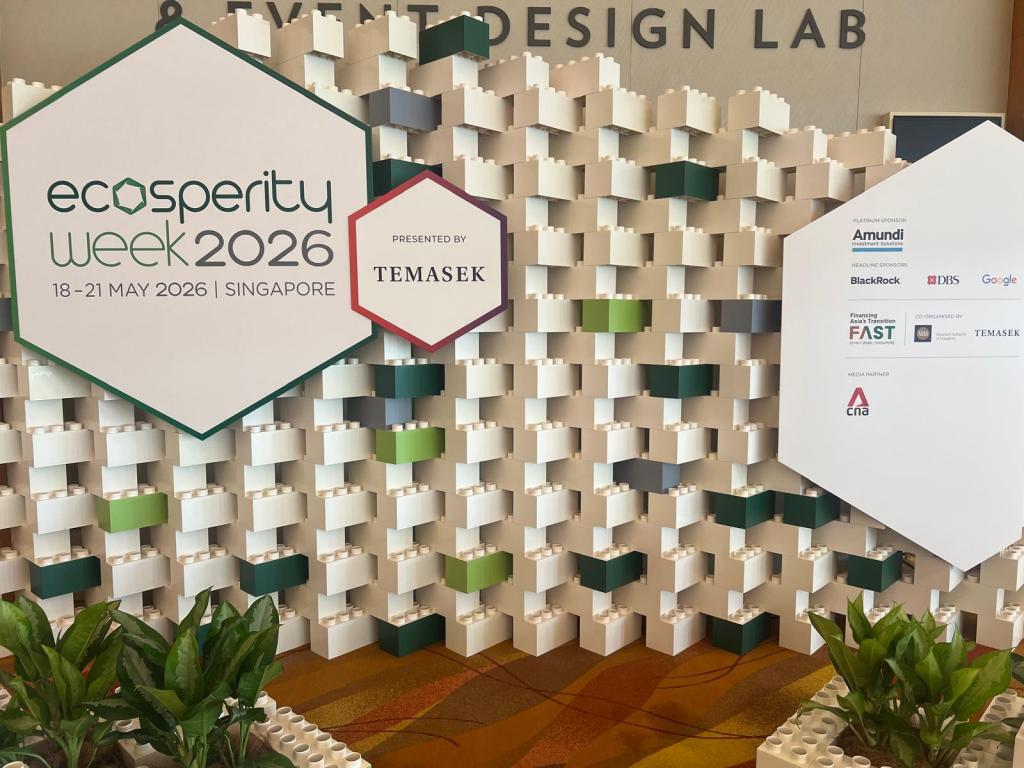
As I wrapped up my 5th year at Ecosperity last week, I couldn’t help but wonder how it has evolved over the decade from just being Temasek’s sustainability platform to now well and truly being the pinnacle summit for climate leadership in Asia. The transformation is quite phenomenal – from a half-day gathering of ~200 people (as per Gemini) to a week long conference across ~60 events, 40 partners and ~4,000 people! But what has stood out for me is the strong focus on implementation across some of the key themes driving climate action in our region – energy transition, decarbonization, technological innovation, transition finance, nature and carbon markets. Ending the conference every year, I have found myself richer in knowledge and replete with confidence that despite the enormous climate challenges, human ingenuity and tenacity will find us a way through this crisis.
Five themes dominated discussions this year:
1. Carbon Markets
After few tumultuous past years battling integrity carbon markets are gradually healing but still under-delivering. Overclaiming of benefits, community incentive structures, fundings gaps and integrity of credits continue to offer impediments to the development of a robust and scalable demand-supply market platform. Educating investors on risk/return dynamics of various carbon projects remains vital – a mangrove vs peatland project offers very different paybacks, time horizons, carbon removals and thereby prices. Usage of technology for MRV is becoming critical in establishing true integrity of credits. CDR (CO2 Removals) – both nature based and tech based – will be critical components of a balanced carbon portfolio, based on impact, risks, pricing and ultimately organization strategy of the buyers. Ultimately, both reductions and removals will need to go hand-in-hand and incentives to buyers through right policies may just help boost demand.
2. Nature for Business
Nature is gaining traction, increasingly (and rightly!) discussed as the other side of the coin opposite to Climate. But nature remains heavily under-invested: it’s tough to measure, is not priced effectively as an externality and is often not bankable. Singapore has taken the lead on Nature Based Solutions by focusing on 3 pillars: High integrity (core carbon principles), High demand (buyers coalitions, long-term offtake agreements) and High supply (robust project development, blended finance). For the private sector, nature needs to go beyond compliance and into the realm of value & resilience. FIs are adding nature into financing frameworks and linking it to adaptation & resilience in order to build a business case. Getting capital to target specific bottlenecks in the supply chain will lead to value creation.
3. Energy Transition to Security
Global geo-political upheavals have meant that past discussions on energy transition have now pivoted to focus on energy security instead – but that has only further validated that energy transition is actually the key driver to energy security! The world has witnessed first hand the risks of depending only on fossil fuels that have been subject to supply chain bottlenecks, and that is further accelerating deployment of renewable farms, battery storage systems, and grid transformation investments. With solar now cheaper than grid power in many regions, renewables are not just a supply-chain risk mitigation option, but a commercially superior energy alternative on their own. However, the biggest challenge lies with ailing grid infrastructure in most Asian markets, esp. with the need for smart grids to deal with multiple sources and intermittency. The ASEAN Power Grid aims to tackle that issue head-on and Multilateral Development Banks are working hard to scale this up.
4. Infrastructure for Resilience
Gone are the days when infrastructure alluded to transportation and energy as default – today, its data centres that are drawing huge investments globally. But with that come significant issues around grid interconnection deluge, behind the meter renewable solutions, water resilience as well as social license to operate. As per one of the comments, ~30-50% of DCs are delayed today due to grid permits. A much less appreciated fall out of this growth is the need for critical minerals, which are the ingredients for all latest chips and cutting-edge equipment needed to power the AI boom. I was shocked to hear that ~20-40 tons of copper are needed for each MW of AI DCs – so we need $60B of Cu mines that don’t even exist today.
5. Catalyzing Capital
As expected, this remains the biggest bugbear for climate action. The Monetary Authority of Singapore is doubling down on 3 levers: Getting concessionary capital through FAST-P blended finance initiatives, strengthening market frameworks like the transition finance taxonomy and building resilience through increasing climate adaptation financing. But emerging economies need $1.3T of transition financing vs $200B they get at present – and private sector needs to contribute 60-80% of that from 10-20% today. The other challenge is that 80-90% of today’s private capital is coming from debt and not equity, and Asian currencies have made achieving IRR thresholds even harder. All these point to the need for larger private equity play in hard to abate sectors, channeling more domestic capital, and balancing short term returns with long term decarbonization. Finally, much discussions are focusing now on climate adaptation and resilience bankability, with insurers and reinsurers taking centre-stage. One of them even highlighted that a 2-4% higher costs can lead to upto ~40% of reduced future losses. Despite this, making adaptation projects bankable remains a work-in -progress at best.
It was humanely impossible to experience everything at Ecosperity in its fullest depth, given how diverse and concurrent most of the sessions were. But if there is one thing that I take away from the frenetic week, it is the deep gratitude for all the efforts that every actor, big or small, is putting in to ensure that environmental protection goes hand in hand with economic growth. After all – isn’t that what “Ecosperity” has always stood for since the beginning?