

Having spent many years now not only leading large multinational corporate sustainability programs, but also observing how companies across different industries approach their ESG journeys, I have realized that organizations go through what I like to call a “Sustainability Maturity Curve“. While the curve may indicate where you are on your sustainability journey, I think a better way to interpret will be to look at it as an answer to the question: “Why are you doing whatever you are doing on sustainability?”. Framed this way, it removes any judgement on maturity levels of your ESG programs (which I admit is not the intent of the title!), but rather helps you align your efforts and investment of time and resources. When you honestly acknowledge the reasons behind your ESG strategy, it should give you clarity of mind and confidence in your response when confronting questions around how much should I focus on sustainability and what does it do to my business. So what this curve about?
I will give it 5 stages:
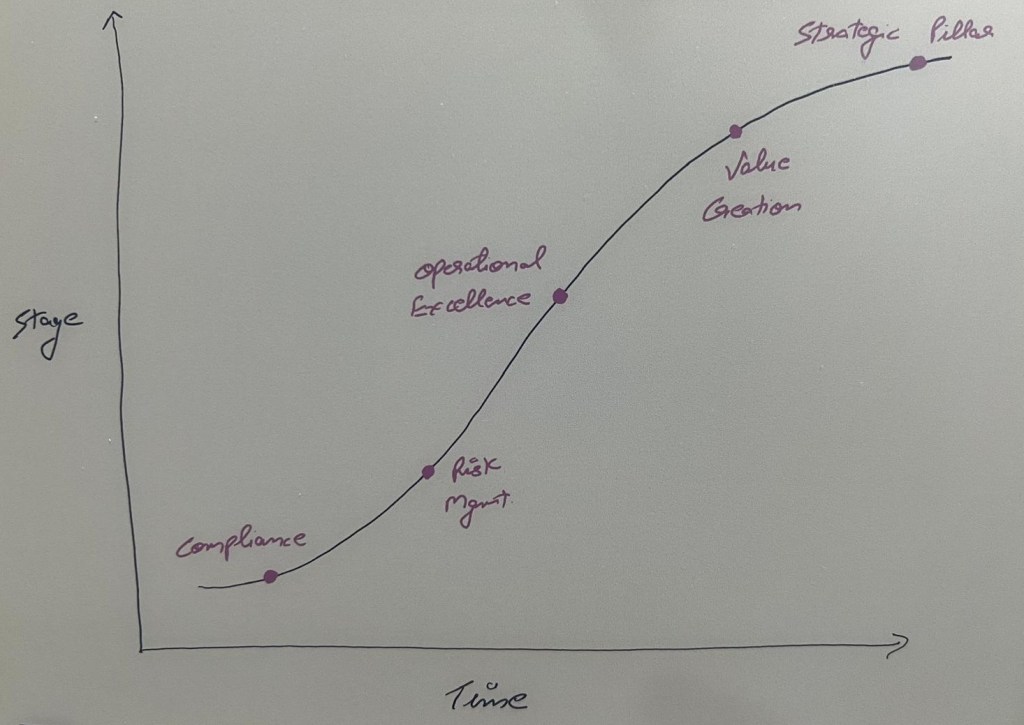
Compliance
In this stage, organizations respond to mandatory disclosure requirements often imposed by their local regulators. This gets them to start organizing relevant ESG data internally, assign ownerships to different teams, and start thinking about how to communicate their sustainability policies, approach and data to external stakeholders. This is also where Boards start paying keen interest to sustainability matters, given the need for their sign off on the sustainability reports.
Risk Management
Focus in this stage is on how to identify, manage and mitigate risks for the business arising out of sustainability issues. This can take various forms and shapes – risk of physical damage to assets due to climate events like flooding, risk of policy changes and customer expectations on the business, reputational risk due to negative impact of a company’s operations on the environment/society and so on. ESG occupies a place in the risk register of companies, and comes on the table of Board Risk Committees.
Operational Excellence
Now the rubber hits the road – businesses start realizing that there are cost savings and operational efficiencies to be had as a result of spending money on green capex. Think of lower utility bills due to a chiller upgrade in a building, cheaper power due to rooftop solar investments, IoT sensors that can automate irrigation and minimize water loss – I suppose you get the drift. Sustainability now becomes a driver of opex reduction, and the discourse moves from the corridors of sustainability and risk teams to the realms of operations and commercial management.
Value Creation
This is where sustainability starts getting truly embedded into business models. Teams now start identifying and pushing all levers where ESG efforts and investments can not only improve efficiency and reduce opex, but can also identify new revenue streams, differentiate existing products, help enter new business segments/markets, rewire supply chains, improve financing terms, win new customers and enhance business valuation among others – everything that can uplift EBITDA in the long run and improve ROIs.
Strategic Pillar
Companies in this stage have truly integrated sustainability as a strategic imperative. ESG factors are central to how business decisions are taken across the lifecycle from investments to operations and embedded into balance scorecards, systems, processes and policies. Every layer from leadership to management to all staff are trained to continuously look at how sustainability can provide a competitive edge in the market with customers, investors and suppliers alike, and how ESG is a core part of corporate strategy development and execution.
Many times simplistic articulation of complex topics can lead to misinterpretations and incorrect conclusions – so as we look at the curve and its stages, it is important to keep the following in mind:
- Climbing the curve is almost never sequential in practice – you will always be overlapping across stages at different points in time, and in fact may even be at different stages for different business units.
- Not everyone has to “climb” the curve! You may chose to stay at a particular stage for various reasons – market conditions, shareholder preferences, competitor dynamics and so on. So look at the curve not as a judgement on how much you care about the environment and society, but as a business decision on how you want to balance the various trade-offs.
- Be aware of where you are on this curve and why are you there – that will makes your sustainability decisions more logical and easier to explain to your stakeholders.
Ultimately, corporate sustainability is a journey and not a destination, with nuanced layers of personal aspirations, business impact, stakeholder expectations and time horizons all intricately woven together. Visionary leaders are those who know how to untangle this delicately.

