
We live in a world where infinite information is available at the swipe of a finger, and where obdurate opinions turn friends into foes on social media platforms. Our opinions consume us and make us arrogant, because we feel empowered by that information treasure trove on our devices. But when those opinions are not backed up by facts, that’s where the world starts appearing far more caustic than it actually is.
I am ever so grateful to a colleague of mine who recently recommended a book to me that I now strongly feel should be read by every human being, irrespective of their location, vocation or interests. I have never written a book review before, and neither have I ever recommended any reading that is applicable to such a wide spectrum of audience, but after devouring “Factfulness: Ten Reasons We’re Wrong About The World – And Why Things are Better Thank You Think”, I couldn’t help but dedicate this blog to the most impressive and yet simple insights about the world I have read in a long time. Highly recommended by Bill Gates and Barack Obama among others, this book is even more relevant for everyone in times of this pandemic as it so eloquently provides a fact-based view of our world as against the heavily biased and media-influenced opinions that we are bombarded with every day. Starting with a quiz, replete with insightful charts/graphs and humorous anecdotes, and breaking down health and economics through such simple, innovative and vivid illustrations, the book is a fast-paced read, funny and serious at the same time.

If you were asked very simple questions about global trends – on population, poverty, education, healthcare, environment – you would think that you would ace them with ease. But when authors Hans Rosling, Professor of International Health and a global TED phenomenon, along with Ola and Anna Rosling started posing these questions to eminent audience from all walks of life – doctors, teachers, lecturers, scientists, investment bankers, CEOs, journalists, activists, politicians and even Nobel laureates – basically highly educated people, stunningly most of them got most of the answers wrong! In fact, so wrong, that a chimpanzee picking the answers at random would have done better than them. Shocking, right? How can some of the most intelligent people on this planet display such ignorance about the world? How can most people in the world be so wrong about their own world? Han’s findings told him that it was not because of lack of knowledge or up-to-date information, but due to the overdramatic worldview that is constantly fed to us that satiates our brain’s natural thirst for drama and extremes. This blocks our ability to look at the world in fact-based manner, backed up by real data. This fact-based view is not exciting, not dramatic, doesn’t tantalize our senses, and may even be boring to discuss with anyone. But it’s the truth – it’s the mundane truth that the world today is a far better place to live in than even before, on any criteria that you may want to measure it on. But this change happens slowly, and gets drowned under the din of screaming new channels that make us believe that the world couldn’t have been worse. It is this perception of drama that blocks our rational senses and prevents us from using facts and data to evaluate happenings around us. Specifically, Hans talks about 10 dramatic instincts that cloud our ability to think rationally and logically, and these instincts are as relevant in understanding the world around us, as they are for any other aspect of our lives – our professions, our family and our attitude in general.
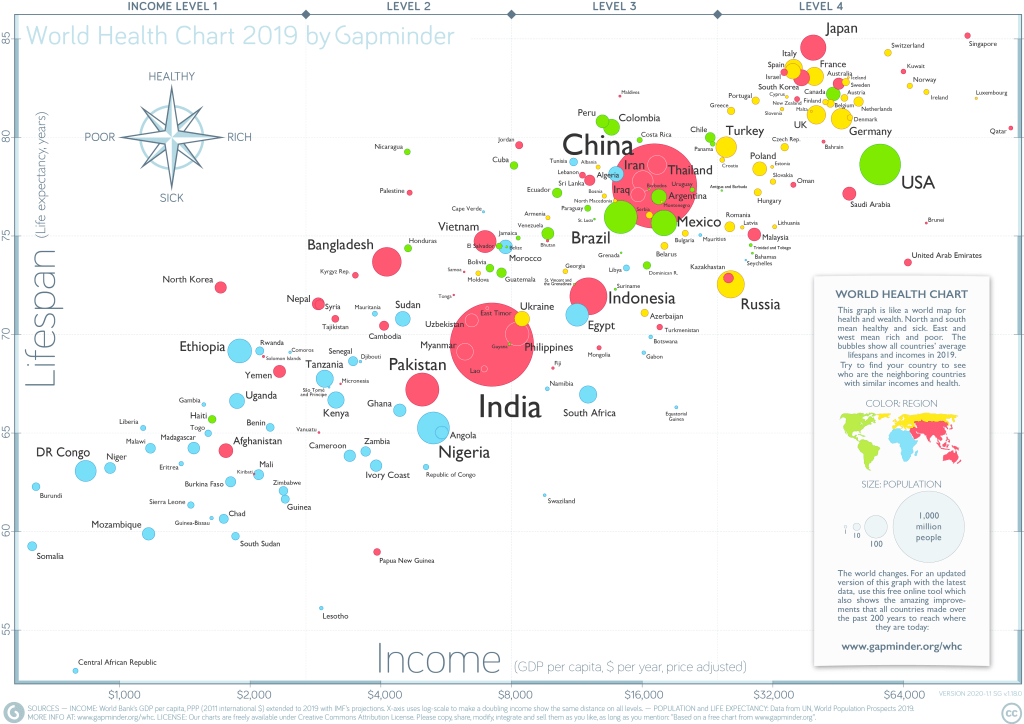
- Gap Instinct: This refers to our temptation to divide all things into two distinct and often conflicting groups, with an imagined gap in between. (e.g rich and poor countries). The reality in life is not in extremes, and the majority are right in the middle of that gap. Comparison of averages and comparison of extremes in two sets of data can both be equally damaging. As a foundation of the book, Hans divides the world in 4 income levels, each level characterized by drinking water, means of transportation, way of cooking, type of food and facilities of sleeping. I found this way of thinking a much more realistic way of understanding the world, than blindly characterizing every country as either rich or poor.
- Negativity Instinct: This is about our tendency to notice the bad more than the good – ‘things are getting worse’, is the most often heard statement about the world which couldn’t have been farther from the truth. (from poverty to life expectancy to child mortality to battle deaths – the world is getting much better, contrary to our negativity instinct). Media will bombard us with negative news as it’s dramatic, while positive changes are gradual and thus less exciting, which creates a negative impression of the world around us.
- Straight Line Instinct: This is the assumption that line graphs will always continue straight, but many global trends are rather curves, humps, S-bends etc. The shape of global population forecast curve is one such example.
- Fear Instinct: This instinct presents us an image of the world as dangerous as it could ever be, fueled by the media tapping into this instinct to grab our attention. Natural disasters, plane crashes, terrorism, wars – while these fears are not unrealistic, but it’s well-proven by facts that the world is a far safer and less violent place than it ever has been. (trivia: flying has gotten 2,100 times safer over the last 70 years; no. of deaths from natural disasters is just 25% of what it was 100 years ago!)
- Size Instinct: This is one of my personal favorites and I find it very relevant in the corporate world of number crunching and data analysis. People typically get things out of proportion, and misjudge the magnitude of things, and thus a lonely number seems far more impressive than it actually may be. Comparing numbers together, using the 80/20 rule and normalizing data on a per unit basis will give us a much more accurate sense of proportion and comparison of data.
- Generalization Instinct: This is another personal favorite because I see this all the time all around me, and even I am guilty of it many times. Our minds are tuned to categorize and generalize things to make sense of the world, often resulting in stereotyping. An example is how we generalize about countries/regions we have never travelled to. An American never been to India may generalize how Indians live based on his opinions influenced by media, without appreciating that a rich man in Mumbai may live in far greater luxury than a poor man in Manhattan. To avoid generalizing, we must look for differences within and across groups. We must also beware of ‘majority’ – something I see regularly at work. When someone mentions majority, it could mean 51% or 99%, and each could have very different implication on the matter at hand!
- Destiny Instinct: This is the idea that innate characteristics determine the destinies of people or countries, a belief that things have always been a certain way and will never change. I loved the example Hans used to make this point. It is commonly touted that people from religion X have much bigger families than others. If you divide the world into different religions, and for each religion, plot the population on a graph with X-axis being income level and Y-axis being babies per woman, you will clearly see that there is a clear reverse link between income and babies per woman – irrespective of religion! We must remember that big changes across cultures and countries happen very slowly, and no one is ‘destined’ to remain in a certain way forever.
- Single Perspective Instinct: Another one that is a lifeline especially for leaders in the corporate world. This instinct lets us believe all problems have a single cause or a single solution – it makes the world very simple in our mind, whereas in reality, the world is extremely complex and looking at issues from multiple perspective even if they are not within our domain of expertise is imperative if you want to get closer to the facts. Often it is our ideologies and our professions that instill a bias in us of being unable to look at things from various perspectives. The book shows a beautiful example of Cuba on the health-wealth bubble chart. Depending on how you interpret Cuba’s position on the chart vis-à-vis other countries, it can either be made out to be the healthiest of the poor countries, or poorest of the healthy countries – while in reality it is both. If you get stuck in the single perspective instinct, you will be led to a narrative that suits the narrator instead of your brain processing the facts in a rational manner. It is imperative to look at a problem from all angles to find more practical and holistic solutions – something every professional from any field must always keep in mind.
- Blame Instinct: As the name suggest, this is the instinct to always attribute a simple reason and blame on to someone when something bad happens. We often tend to look for the bad guys that confirm to our existing beliefs and opinions, and find solace in that – evil businessmen, lying reporters, corrupt politicians – it’s easy to pin blames as a cause of some of the most complex problems on earth. Real world is far more complex, and we must resist the urge to blame an individual or a group, as that gets us to stop thinking beyond the blame, and try to uncover the root causes of complex issues. As the book says, look for causes, not villains.
- Urgency Instinct: ‘It’s now or never! If you don’t act now, or change your thinking now you will regret it for the rest of your life!’ How many times have you heard these around you? That’s precisely what the Urgency Instinct is – the call to action that makes you think less critically and decide more quickly even when almost always in reality, it’s never that urgent. When a decision feels urgent, always take a breath and be wary of drastic actions.
End of the day, there are three reasons why I found Factfulness one of the most enlightening and inspiring books I have read:
- It provides us a fact-based worldview, which makes us aware of the biased pair of eyes with which we so often look at the world. And when we do that, we will realise that the world is not as bad as it seems to be – yes it has serious problems that we need to continue to work hard at, but it is also far better on almost all counts than it ever was in the past.
- Irrespective of whether we are curious about the world around us or not, the book shows us the power of using facts and data on any issue we deal with in our life, and how devastating it can be when we carry opinions which are biased and not supporting by facts. At many levels, the book is about our attitude towards our lives, and how we can become more positive and less stressed when we embrace critical thinking over dramatic instincts.
- Lastly, and probably most importantly, it makes us feel humble and curious to learn – two qualities that the world today so desperately needs!
Hans Rosling, together with Ana and Ola, decided to write this book in 2015 as a tribute to his lifelong work on creating a fact based worldview and dispelling ignorance. A year later he was diagnosed with cancer and in early 2017, he left for the heavenly abode. Ana and Ola continued his dream and lead his mission today through their efforts. Google about them and watch Han’s TED talks if you haven’t – they have influenced my thinking, and hope they do yours too!
 Vinz's World
Great review..definitely going to read it…thanks for sharing!!
LikeLike